
Blog / Missing Middle Housing
Toronto Private Tree By-law: How Trees Shape a Multiplex Redevelopment
Written by Anthony Palleschi · November 28, 2026 · 9 min read
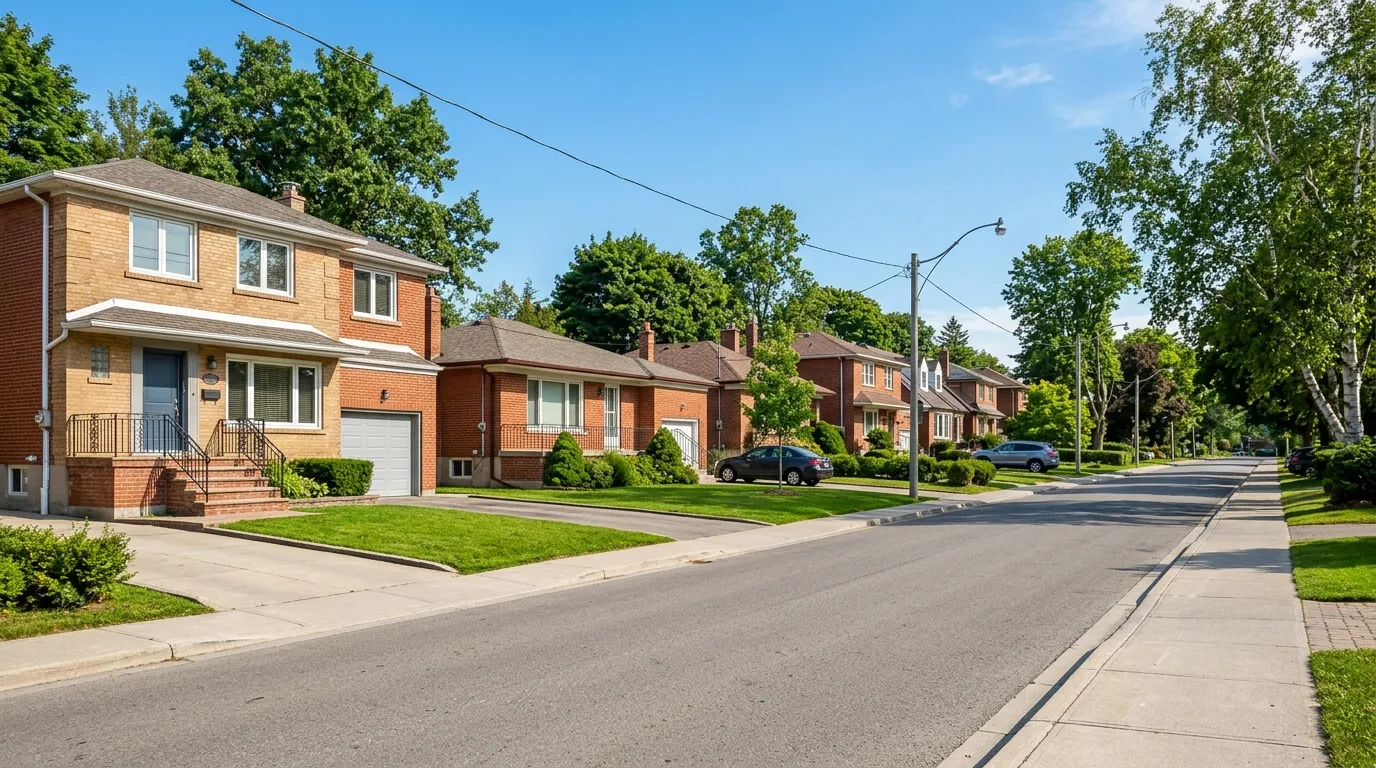
Toronto has one of the largest urban tree canopies of any major North American city, and the City goes to considerable lengths to keep it that way. The private tree by-law, Chapter 813 of the Toronto Municipal Code, protects every tree on private land with a trunk 30 centimetres or more in diameter. A protected tree cannot be removed or injured without a permit, and the City can refuse the permit or attach conditions. For a Missing Middle project, the tree by-law is one of the first things to check on a lot.
I'm Anthony Palleschi, a real estate sales representative in Toronto, and I work with owners and builders on sites where a tree is part of the file. This post sets out what the by-law covers, how it changes a design, and what each step costs in time and money.
What the by-law protects
Chapter 813 applies to every tree on private land with a trunk diameter of 30 centimetres or more, measured at 1.4 metres above the ground. The measurement is called diameter at breast height, or DBH. A tree with a 30-centimetre DBH has a circumference of about 94 centimetres, roughly the thickness of a utility pole.
| Trunk diameter at breast height | Rough age for a sugar maple | Typical replacement ratio |
|---|---|---|
| Under 30 cm | Under 25 years | Not protected (permit still advised) |
| 30 to 50 cm | 25 to 50 years | 3 replacement trees |
| 50 to 75 cm | 50 to 80 years | 5 to 7 replacement trees |
| 75 cm or more | 80 years or more | 9 or more trees, or cash in lieu |
A City-owned tree, including a street tree and a park tree, is always protected under separate by-laws (Chapter 658 for street trees, Chapter 608 for parks), with no size threshold. The same goes for a boulevard tree that is in front of the lot, even if its trunk is on the property line.
When a tree stops a build
A tree stops a build in two situations. The first is where the tree is in the middle of the buildable area on a small lot, and the design will not fit around a Tree Protection Zone. The second is where the City refuses the removal permit.
Urban Forestry refuses a permit when the tree is healthy, is of a species the City wants to keep (white oak, sugar maple, black walnut), and the applicant has not explored a design that keeps the tree. The refusal letter usually asks for a revised design that keeps the tree, not a repeat of the same application.
Three tree facts that make a refusal more likely:
- The tree is native to Ontario and part of the City's heritage species list.
- The tree is over 50 centimetres in diameter.
- The tree is in a neighbourhood where the canopy is already below the City's target.
Three tree facts that make a permit more likely:
- The tree is in poor health, with signs of decline the arborist can document.
- The tree is an invasive species, for example a Norway maple.
- The tree is sitting directly over the proposed foundation and cannot be designed around.
Tree Protection Zones during construction
A tree that stays needs a Tree Protection Zone, or TPZ, during construction. The TPZ is a fenced area around the tree that keeps the foundation work, the excavation, the storage of materials, the vehicle traffic and the compaction of soil away from the roots.
The size of the TPZ is set by the trunk diameter. The usual ratio is 10 centimetres of TPZ radius for every centimetre of trunk diameter.
- Tree with a 30-centimetre DBH: TPZ radius of 3 metres (about 10 feet).
- Tree with a 50-centimetre DBH: TPZ radius of 5 metres.
- Tree with a 75-centimetre DBH: TPZ radius of 7.5 metres.
A 50-centimetre tree in the middle of a 10-metre-wide back yard effectively consumes the yard during construction. The building usually has to be pulled toward the street or the design has to work with a smaller rear footprint. For how the angular plane and the step-back interact with a rear yard constraint, see my angular plane post.
The permit process
A private tree permit application goes to Urban Forestry through the City's Development Review system. For a multiplex project, the tree permit is usually processed with the building permit, so the reviews run in parallel.
The steps:
- Arborist report. A certified arborist walks the lot, lists every tree 30 centimetres or more in diameter, records the DBH, the species, the condition and the location on a site plan. The report is the start of the application.
- Tree Protection Plan. The plan shows the TPZ for every tree that stays, the construction fencing, the soil protection measures and the traffic routing.
- Removal application. For each tree the design wants to remove, a separate application form states the reason (dead or dying, in the way of the foundation, in the way of the side setback) and the proposed replacement.
- Urban Forestry review. A Forestry officer visits the site, reads the arborist report and the Tree Protection Plan, and issues a decision.
- Permit and conditions. The permit sets out the trees that may be removed, the replacement trees, the TPZ fencing and the inspection schedule.
- Replacement planting. After construction, the replacement trees are planted on site where possible. Where on-site planting is not possible, the applicant pays cash in lieu to the Tree Reserve Fund at a set per-tree rate.
The permit fee in 2026 is $115 per tree for a residential application, with the arborist report the main cost (usually $1,000 to $2,500). The cash in lieu amount is set by Council and is in the range of $600 to $800 per replacement tree.
How it affects the lot price
A tree on a Toronto lot is a line in the proforma, not a stop sign. The size of the line depends on where the tree sits.
Lot value impact by tree location:
- Front yard, near the street. Usually kept with a TPZ. Lot value largely unaffected.
- Side yard, against a lot line. Often kept with a TPZ, sometimes removed with a routine permit. Lot value reduced by 2 to 5 percent.
- Rear yard, against the rear lot line. Often kept, sometimes removed. Lot value reduced by 2 to 10 percent, depending on the tree size and species.
- Middle of the buildable area. The problem case. Lot value reduced by 10 to 20 percent, sometimes more on a small lot. On the smallest lots, the tree can take the project off the table.
For the broader pricing framework, see how builders price land in Toronto. For other site conditions that change the price, see toronto corner lots multiplex opportunities and my post on land transfer tax on a lot with a house compared with vacant land.
A lot walk for trees
An arborist walks the lot in an afternoon and gives a 2 to 3 page report the next day. The report costs around $1,000 to $2,500 and answers the three questions that decide the offer:
- How many protected trees are on the lot?
- Where is each one?
- What is the trunk diameter and the species of the largest one?
For a lot I am helping a client with, I ask for the arborist report before the offer where possible. If the report comes back with one or two trees at the edges of the lot, the project moves forward on the planned price. If the report comes back with a 70-centimetre oak in the middle of the back yard, the price moves, or the project changes.
Common mistakes
- Removing a tree before the application. A protected tree removed without a permit is a $100,000 fine risk and ends the goodwill with Urban Forestry on the file.
- Assuming the lot is empty because the trees are small. A row of 15-centimetre trees along a fence does not trigger the by-law today, but one or two of them may be 30 centimetres in five years.
- Forgetting the boulevard tree. The tree in front of the lot is a City tree. A new driveway, a new sewer connection or a new utility service that cuts roots is a separate application to Urban Forestry.
- Missing the TPZ in the design. A TPZ outside the building footprint still constrains the construction work. A plan without a TPZ on the drawings is incomplete.
- Underestimating the replacement cost. Nine 60-millimetre trees supplied and planted is a line item worth $5,000 to $10,000. Cash in lieu for nine trees is in the same range.
Questions to ask about your lot
- How many trees on the lot have a trunk 30 centimetres or more across?
- Where is the largest one, and what is its species?
- Is the largest one in the buildable area for a multiplex?
- Is there a City boulevard tree in front of the lot?
- What would the Tree Protection Zone look like on a site plan?
If you want to walk through what the tree by-law means for a specific lot, see how I work with sellers and builders, or reach me through the contact page.
Planning and development potential is property-specific and subject to zoning, approvals, site conditions, municipal review and other due diligence.
Sources
All pages opened on November 25, 2026 (PT).
- City of Toronto, Toronto Municipal Code Chapter 813, Trees: the 30-centimetre threshold, the permit requirement, the replacement ratios and the penalty.
- City of Toronto, Urban Forestry, Private Tree Permit: the application process, the fee schedule and the Tree Protection Plan requirement.
- City of Toronto, Tree Protection Policy and Specifications for Construction Near Trees: the TPZ ratios and the construction fencing requirements.
- City of Toronto, Street Trees By-law, Chapter 658: protection for boulevard and road allowance trees, with no size threshold.
Frequently asked questions
What is Toronto's private tree by-law?
Toronto Municipal Code Chapter 813 is the City's private tree by-law. It applies to every tree on private land with a trunk diameter of 30 centimetres or more, measured at 1.4 metres above ground. A permit is needed to injure or remove any protected tree. The by-law is enforced by Urban Forestry, under the Parks, Forestry and Recreation division.
What size tree is protected in Toronto?
A tree with a trunk diameter of 30 centimetres or more, measured at 1.4 metres above ground, is protected on private land. A tree with a smaller trunk is not protected under Chapter 813. A tree on City land, including a street tree or a park tree, is always protected under the City's road and parks by-laws, no matter the size.
Can I remove a tree to build a multiplex in Toronto?
You can apply to remove a protected tree, but you cannot remove it without a permit. Urban Forestry assesses the application against the tree's health, species, size and contribution to the canopy, and the alternatives available on the site. The City can refuse a permit or issue it with conditions, including a replacement planting ratio.
How many replacement trees do I have to plant in Toronto?
The replacement ratio depends on the size of the removed tree. For a tree 30 to 50 centimetres in diameter, the replacement is usually three trees. For a tree 50 to 75 centimetres, it is five to seven. For a tree 75 centimetres or more, the replacement can be nine or more trees, or a cash in lieu payment to the Tree Reserve Fund where planting space is not available on site.
What happens if I remove a Toronto tree without a permit?
The penalty is up to $100,000 for a first offence, with the exact amount set by the court. The by-law is a strict liability by-law, so a builder who removes a protected tree without a permit is liable even if the owner did not know the tree was protected. An unauthorized removal also triggers an inspection of the rest of the site.
How long does a tree permit take in Toronto?
A standard private tree permit takes 10 to 20 business days to process. A permit tied to a building application can take longer, because Urban Forestry's review is part of the Toronto Building review. For a multiplex application, the tree permit is usually conditional on the building permit, so the two timelines run together.
What is a Tree Protection Zone in Toronto?
A Tree Protection Zone (TPZ) is the area around a protected tree that must be kept clear during construction. The TPZ is set by Urban Forestry based on the trunk diameter, usually 10 centimetres of TPZ radius for every centimetre of trunk diameter. A tree 40 centimetres in diameter needs a 4-metre TPZ around its trunk. Construction inside the TPZ needs a separate permit.
How does a tree affect the price of a Toronto multiplex lot?
A protected tree in the middle of the buildable area can reduce the lot value by 10 to 20 percent, because the tree either stays and the design is smaller, or the tree is removed and the project pays for replacement trees and the permit review. A tree in the front yard or against a side lot line can usually be kept with a Tree Protection Zone, and the lot price is largely unaffected.