
Blog / Missing Middle Housing
Land Transfer Tax on a Toronto Lot: A House vs Vacant Land in 2026
Written by Anthony Palleschi · October 28, 2026 · 7 min read
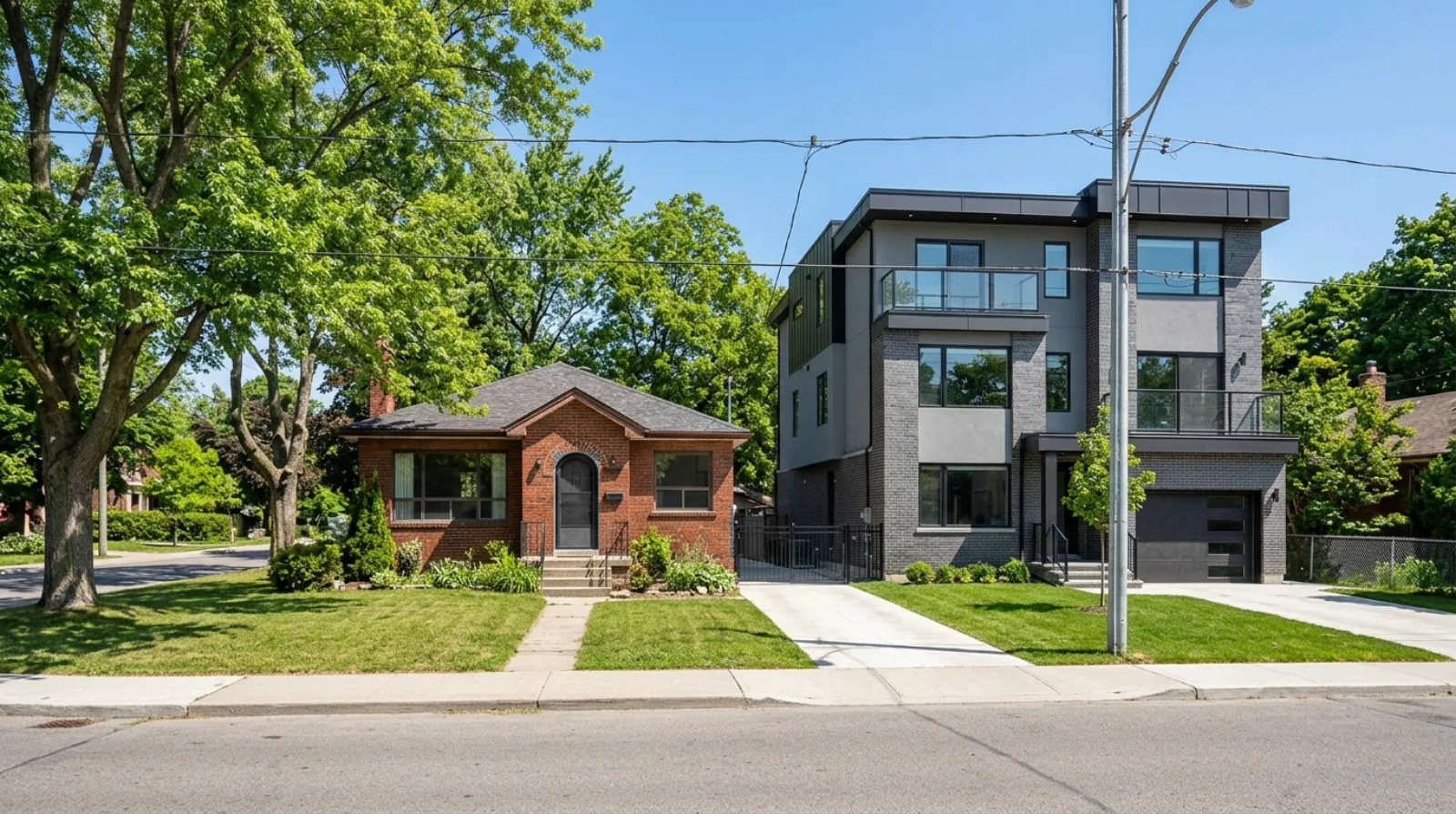
When a builder buys a house lot in Toronto, two land transfer taxes come due at closing: Ontario's and the City's. Both use steps, so each rate applies only to the part of the price inside its step. Above $2,000,000, both charge more when the land has one or two houses on it, and Toronto added higher steps again from April 1, 2026.
I'm Anthony Palleschi, a real estate sales representative in Toronto, and I work with owners and builders on lots for multiplexes and small apartment buildings. This post covers one cost, the land transfer tax, using the Ontario and City rate pages as they read on November 1, 2026. For the full set of costs in a multiplex budget, see the guide, Is a Toronto multiplex worth building?
The two rate tables
Both governments publish two tables: one for land that contains "at least one, and not more than two, single family residences," and one for other land.
| Part of the price | Land with 1 or 2 houses: Ontario | Land with 1 or 2 houses: Toronto | Other land: Ontario and Toronto |
|---|---|---|---|
| Up to $55,000 | 0.5% | 0.5% | 0.5% |
| $55,000 to $250,000 | 1.0% | 1.0% | 1.0% |
| $250,000 to $400,000 | 1.5% | 1.5% | 1.5% |
| $400,000 to $2,000,000 | 2.0% | 2.0% | 2.0% |
| $2,000,000 to $3,000,000 | 2.5% | 2.5% | 2.0% |
| $3,000,000 to $4,000,000 | 2.5% | 4.40% | 2.0% |
| $4,000,000 to $5,000,000 | 2.5% | 5.45% | 2.0% |
| $5,000,000 to $10,000,000 | 2.5% | 6.50% | 2.0% |
| $10,000,000 to $20,000,000 | 2.5% | 7.55% | 2.0% |
| Over $20,000,000 | 2.5% | 8.60% | 2.0% |
The Ontario rates are from the province's calculating land transfer tax page, updated April 22, 2026. The Toronto rates are from the City's rates and fees page, last changed April 7, 2026. The City's main land transfer tax page says Council introduced "graduated Municipal Land Transfer Tax rates for high-value residential properties" that "take effect on April 1, 2026."
Worked examples
These figures are my own arithmetic from the published rates, before any rebate. The prices are examples, chosen to show where the tables split.
| Price | Land with a house | Land without a house | Difference |
|---|---|---|---|
| $1,500,000 | $52,950 | $52,950 | $0 |
| $2,500,000 | $97,950 | $92,950 | $5,000 |
| $3,500,000 | $157,450 | $132,950 | $24,500 |
| $4,500,000 | $231,700 | $172,950 | $58,750 |
Up to $2,000,000, the two tables match, so the house makes no difference. Above $2,000,000 the gap opens, and above $3,000,000 it widens because of Toronto's April 2026 steps.
At $3,500,000, for example, the Toronto tax on land with a house is $83,475 and the Ontario tax is $73,975. On land without a house, each is $66,475.
How to calculate it step by step
Each rate applies only to the part of the price inside its step, so you add the steps up. Here is the Toronto tax on a $3,500,000 purchase of land with a house on it:
| Part of the price | Amount in the step | Rate | Tax |
|---|---|---|---|
| Up to $55,000 | $55,000 | 0.5% | $275 |
| $55,000 to $250,000 | $195,000 | 1.0% | $1,950 |
| $250,000 to $400,000 | $150,000 | 1.5% | $2,250 |
| $400,000 to $2,000,000 | $1,600,000 | 2.0% | $32,000 |
| $2,000,000 to $3,000,000 | $1,000,000 | 2.5% | $25,000 |
| $3,000,000 to $3,500,000 | $500,000 | 4.40% | $22,000 |
| Total | $3,500,000 | $83,475 |
The Ontario tax on the same purchase uses 2.5 percent for the whole part above $2,000,000: $36,475 for the first $2,000,000 plus $37,500 for the next $1,500,000, or $73,975. On land without a house, both governments charge 2.0 percent on the whole part above $400,000, which gives $66,475 each.
To check a figure yourself, use the same method with the rates in the table above and the price in your agreement.
When and how it is paid
Ontario's land transfer tax page, updated October 29, 2026, says "Ontario's land transfer tax is payable when the transfer is registered." If the transfer is not registered within 30 days of closing, a return must be filed and the tax paid within 30 days after closing.
Extra information for home purchases
The same Ontario page says buyers of land that contains "at least one and not more than six single family residences," or agricultural land, must give additional information when they register the transfer. Ask your lawyer what the form needs. It is a reporting step, separate from the tax rate.
Why this matters on a redevelopment lot
This section is my own view.
At prices up to $2,000,000, the two tables give the same tax. The difference matters on higher-priced lots and on Major Street sites where a builder joins two or three lots.
For a land assembly, each purchase is a separate transfer, taxed on its own price. Two lots bought for $1,500,000 each are taxed as two $1,500,000 transfers, $52,950 each and $105,900 in total. One lot bought for $3,000,000 with a house on it would be taxed at $122,950 in total. The steps reward smaller separate purchases. A builder comparing two sites at different prices should work out the tax on each, because the step at $2,000,000 can change the cost of one site and leave the other the same.
Whether a particular lot counts as land with one or two single family homes on the day of closing is a legal question. A lot with a house on it, a vacant lot and a lot with a building of three or more units can each fall under a different table. Ask your lawyer before you assume either rate, and do not change a plan only to change the tax without that advice.
What it means for owners selling to a builder
The buyer pays land transfer tax. A builder counts it as part of the cost of buying your lot, along with other costs, when they work out an offer. On a sale above $2,000,000, the tax on a lot with a house is higher, and the builder will include that in their numbers.
Questions to ask before you buy or sell
- Is the price above $2,000,000, where the two tables differ?
- Does the land contain one or two single family homes on closing, by your lawyer's reading?
- For an assembly, what is the tax on each separate purchase?
- Are any refunds or rebates available to this buyer, by your lawyer's reading?
- Is the tax in the budget, along with legal fees and closing costs?
If you are buying or selling a lot for redevelopment, see how I work with developers and sellers, or reach me through the contact page or at 416-636-6800.
Planning and development potential is property-specific and subject to zoning, approvals, site conditions, municipal review and other due diligence.
Sources
All pages opened on November 1, 2026 (PT).
- Government of Ontario, Calculating land transfer tax (updated April 22, 2026): the provincial rates for land with one or two single family residences and for other land.
- Government of Ontario, Land transfer tax (updated October 29, 2026): payment on registration and the 30-day rule, and the chapter on refunds for first-time homebuyers.
- City of Toronto, Municipal Land Transfer Tax rates and fees (date modified April 7, 2026): the City's two rate tables, including the rates from April 1, 2026.
- City of Toronto, Municipal Land Transfer Tax: the graduated rates for high-value residential properties from April 1, 2026.
Frequently asked questions
How much land transfer tax do you pay in Toronto?
A buyer in Toronto pays both Ontario's land transfer tax and the City's municipal land transfer tax. Both start at 0.5 percent on the first $55,000 and rise in steps to 2.0 percent above $400,000. On a $1,500,000 purchase each tax is $26,475, for $52,950 in total, before any rebate.
What are Toronto's new land transfer tax rates from April 1, 2026?
For land with one or two single family homes, the City of Toronto's municipal land transfer tax rates from April 1, 2026 are 4.40 percent from $3,000,000 to $4,000,000, 5.45 percent to $5,000,000, 6.50 percent to $10,000,000, 7.55 percent to $20,000,000 and 8.60 percent above that. The lower steps did not change.
Is land transfer tax lower on vacant land in Toronto?
Above $2,000,000 it can be. Ontario and Toronto charge their higher rates only on land that contains one or two single family homes. Under the published tables, other land pays 2.0 percent on the part above $400,000. On a $3,500,000 purchase, the combined tax is $157,450 with a house and $132,950 without one.
When is land transfer tax paid in Ontario?
Ontario's land transfer tax page says the tax is payable when the transfer is registered, and that buyers pay it to the province when the transaction closes. If a transfer is not registered within 30 days of closing, a return must be filed and the tax paid within 30 days after the closing date.
Does a builder pay land transfer tax on each lot in an assembly?
Each purchase in a land assembly is its own transfer, and Ontario and Toronto calculate the tax on the price of that transfer. Buying two lots for $1,500,000 each means two separate taxes on $1,500,000, which at 2026 rates is $52,950 for each lot, or $105,900 in total.
Do the higher Toronto rates apply to a triplex or fourplex?
Toronto's higher municipal land transfer tax rates apply to land with at least one and not more than two single family homes. The City's second table, for all other properties, charges 2.0 percent on the part above $400,000. Whether a multi-unit building counts as one home or several is a legal question for your lawyer.
Can a builder get the first-time homebuyer land transfer tax refund?
Ontario's land transfer tax book has a separate chapter on refunds for first-time homebuyers. Whether any refund or rebate applies to a builder buying a lot to redevelop is a question for a lawyer. Until a lawyer confirms one applies, plan on paying the full Ontario and Toronto taxes at the rates in effect on closing.
Is the 2.5 percent Ontario rate charged on the whole price?
No. Ontario charges each rate only on the part of the price inside its step. For land with one or two single family homes, 2.5 percent applies only to the part above $2,000,000. The first $55,000 is still taxed at 0.5 percent, the next part at 1.0 percent, and so on.