
Blog / Missing Middle Housing
Toronto's $0 Development Charge on the Fifth and Sixth Unit: What By-law 845-2025 Changed
Written by Anthony Palleschi · October 31, 2026 · 6 min read
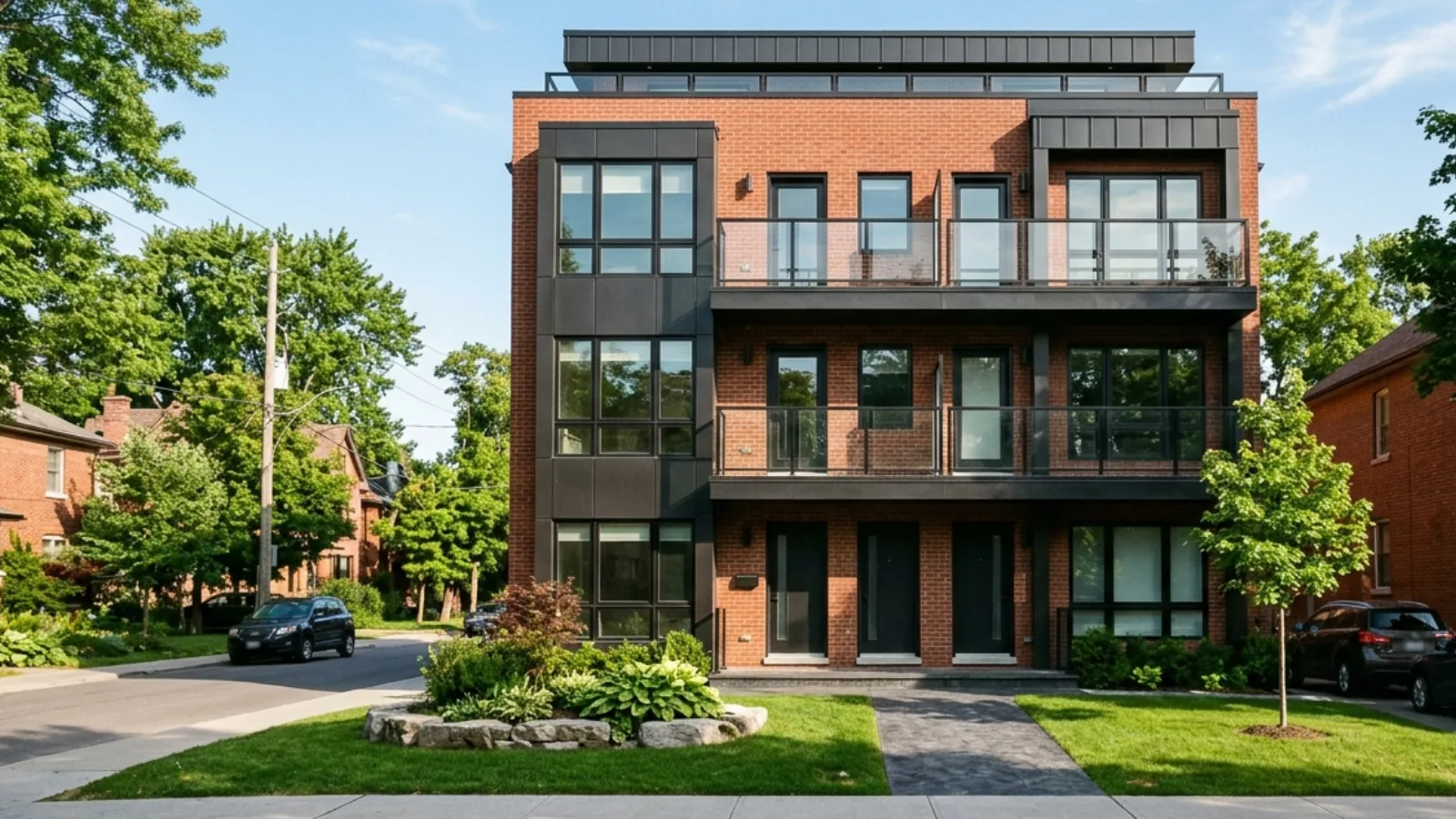
Toronto's development charges are fees the City collects when new homes are built. Small multiplexes pay none on most of their units. In July 2025, the City extended that relief from four units to six by setting the charge on the fifth and sixth unit at zero dollars. This post covers that one change: what By-law 845-2025 says, what it replaced, and where the limit sits now.
I'm Anthony Palleschi, a real estate sales representative in Toronto, and I work with owners and builders on lots that could hold a multiplex. For every City fee and charge on a multiplex, see the full guide, Development charges and City fees on a Toronto multiplex. The texts below are from the City's by-laws and Municipal Code as they read on November 1, 2026.
The rule today
Section 415-6 A(2) of the Toronto Municipal Code, consolidated to July 30, 2026, says that where a unit is not already exempt under Ontario's Development Charges Act, development charges:
(a) Shall not be imposed with respect to the second, third or fourth residential dwelling unit; and (b) For the fifth or sixth residential dwelling unit, shall be reduced to zero dollars ($ 0.00); provided there are no more than six residential dwelling units constructed on a single parcel of land.
The result for a multiplex on one lot:
| Unit | City development charge |
|---|---|
| First | Regular charge, less any demolition credit |
| Second, third and fourth | Not imposed |
| Fifth and sixth | $0.00 |
| Seventh and up | The relief does not apply to any unit |
What it replaced
The wording before July 2025 is set out in By-law 650-2025, enacted on June 26, 2025. It exempted the second, third and fourth unit, "provided that such exemption applies only to a development of no more than four units on such single parcel of land." By-law 650-2025 added one change: a garden or laneway suite proposed as a fifth unit, under the City's deferral agreement, would not count toward the four.
By that wording, from June 26 to July 23, 2025, a fiveplex or sixplex without a qualifying suite fell outside the exemption.
By-law 845-2025
By-law 845-2025 came from Member Motion MM32.5, moved by Councillor Jamaal Myers and seconded by Councillor Josh Matlow, and adopted as amended by City Council on July 23 and 24, 2025. It was enacted on July 24, 2025 and says it "shall come into effect on the date it is enacted and passed."
Its opening text gives three purposes:
- to reduce development charges "for the fifth and sixth unit to zero dollars ($0)" in developments of up to six units on a parcel,
- to leave a garden or laneway suite under a deferral agreement out of the unit count, and
- to exempt the second to sixth unit from parkland dedication, with up to seven units where there is a garden or laneway suite.
The timing matches the zoning. Council allowed fiveplexes and sixplexes in the Toronto and East York district and Ward 23 in By-law 654-2025, enacted June 26, 2025. By-law 845-2025 brought the charge relief up to the same six units four weeks later.
Garden and laneway suites
A garden suite or laneway suite is a separate small home at the back of the lot. Under section 415-6 A(2), a suite that is "the subject of a Development Charge Deferral Agreement for Ancillary Dwelling Units with the City through the Laneway and Garden Suite Development Charges Deferral Program" is not counted in the six-unit total. A suite without that agreement counts as a unit.
For the parkland requirement, section 415-30 (16), as amended again on March 26, 2026 by By-law 269-2026, allows up to seven units on the parcel where one or more is a garden or laneway suite.
The first unit and the seventh unit
The relief starts at the second unit. When a house is torn down for a new multiplex, the Code's redevelopment credit in section 415-7 C reduces the charges by the charge for each home demolished, where the demolition permit was issued within 60 months before a complete building permit application.
At the other end, the relief applies only "provided there are no more than six residential dwelling units constructed on a single parcel of land." A seventh unit on the same parcel takes the whole development outside section 415-6 A(2).
What still applies
Three points sit alongside the six-unit relief:
- Proof is on the owner. Section 415-6 C of the Code says the owner or applicant must show, "to the satisfaction of the City," that they are entitled to the exemption, including that the use is legal under the zoning by-law and building rules.
- School board charges are separate. The City's development charges page says the City collects education development charges on behalf of the Toronto Catholic District School Board, as the Education Act requires. Ask whether that charge applies to your project.
- Timing. The same page says non-rental residential development charges are payable at occupancy, and rental housing charges are payable at occupancy and in instalments.
What it means in practice
This section is my own view.
In the sixplex areas, a sixplex on one lot now carries no City development charges on units two to six, so the charge question no longer favours stopping at four. Outside those areas, the zoning still allows four units in one building, and a fifth home can come from a garden or laneway suite under the deferral program.
For an owner selling in the Toronto and East York district or Ward 23, this is one reason a builder can count on six units, not four, when pricing a lot. For a builder, the six-unit line matters: plan a seventh unit only after working out the full charges it would bring on the whole development.
Questions to ask before you plan
- Will the parcel hold six units or fewer in total?
- Will any garden or laneway suite be under the City's deferral agreement?
- Is the lot in the Toronto and East York district or Ward 23, where the zoning allows six units in one building?
- When was, or will be, the demolition permit issued for the existing house?
- Has Toronto Building confirmed the charge on the first unit?
If you are planning a fiveplex or sixplex, or selling a lot that could hold one, see how I work with developers and sellers, or reach me through the contact page or at 416-636-6800.
Planning and development potential is property-specific and subject to zoning, approvals, site conditions, municipal review and other due diligence.
Sources
All pages opened on November 1, 2026 (PT).
- City of Toronto, Municipal Code Chapter 415, Development of Land (consolidated to July 30, 2026): sections 415-6 A(2), 415-7 C and 415-30 (16).
- City of Toronto, Development charges page: education development charges and when charges are payable.
- City of Toronto, By-law 845-2025, enacted July 24, 2025: the fifth and sixth unit change, the suite rule, the parkland change and Member Motion MM32.5.
- City of Toronto, By-law 650-2025, enacted June 26, 2025: the four-unit wording before July 2025.
- City of Toronto, By-law 654-2025, enacted June 26, 2025: fiveplexes and sixplexes in the Toronto and East York district and Ward 23.
- City of Toronto, Considerations When Building Multiplexes (date modified June 30, 2025): the earlier four-unit wording.
Frequently asked questions
Do the fifth and sixth units of a Toronto multiplex pay development charges?
Under section 415-6 A(2) of the Toronto Municipal Code, as amended by By-law 845-2025, development charges for the fifth or sixth residential unit are reduced to zero dollars, as long as no more than six units are built on one parcel of land. The second, third and fourth units are exempt.
When did Toronto set the fifth and sixth unit charge to zero?
Toronto City Council adopted the change on July 23 and 24, 2025, and By-law 845-2025 was enacted on July 24, 2025. The by-law says it came into effect on the date it was enacted and passed. It came from Member Motion MM32.5, moved by Councillor Jamaal Myers and seconded by Councillor Josh Matlow.
What was the Toronto development charge exemption before July 2025?
Before By-law 845-2025, section 415-6 A(2) exempted the second, third and fourth unit only in a development of no more than four units on one parcel, according to the wording set out in By-law 650-2025 of June 26, 2025. A garden or laneway suite under the City's deferral agreement could be a fifth unit without ending the exemption.
Does a garden suite count toward the six-unit limit for development charges?
A garden suite or laneway suite that is the subject of a development charge deferral agreement with the City, through its Laneway and Garden Suite Development Charges Deferral Program, is not counted in the six-unit total under section 415-6 A(2) of the Toronto Municipal Code. A suite without that agreement counts as a unit.
Is a Toronto sixplex exempt from the parkland payment?
Section 415-30 (16) of the Toronto Municipal Code exempts the creation of a second to sixth residential unit, in the main building or an ancillary building, from the parkland requirement. The exemption applies to developments of no more than six units on one residential parcel, or seven where one or more units is a garden or laneway suite.
What happens if a Toronto multiplex has seven units?
The development charge relief in section 415-6 A(2) of the Toronto Municipal Code applies only where no more than six residential units are built on one parcel of land. A building of seven units on one parcel is outside that relief, and the City's regular development charge rates would apply, subject to any other exemption or credit.
Does the first unit of a Toronto multiplex pay development charges?
The relief in section 415-6 A(2) starts at the second unit. The first unit can be reduced by the Code's redevelopment credit in section 415-7 C, which applies where a demolition permit was issued within 60 months before a complete building permit application. Ask Toronto Building what the first unit would owe.
Why does the City's multiplex page still say four units?
The City of Toronto's Considerations When Building Multiplexes page was last changed on June 30, 2025, before By-law 845-2025 was enacted on July 24, 2025. It still describes the exemption as applying to no more than four units. The Municipal Code, consolidated to July 30, 2026, holds the current six-unit wording.