
Blog / Missing Middle Housing
Is a Toronto Fourplex Worth It? How to Test the Numbers Before You Build
Written by Anthony Palleschi · November 2, 2026 · 9 min read
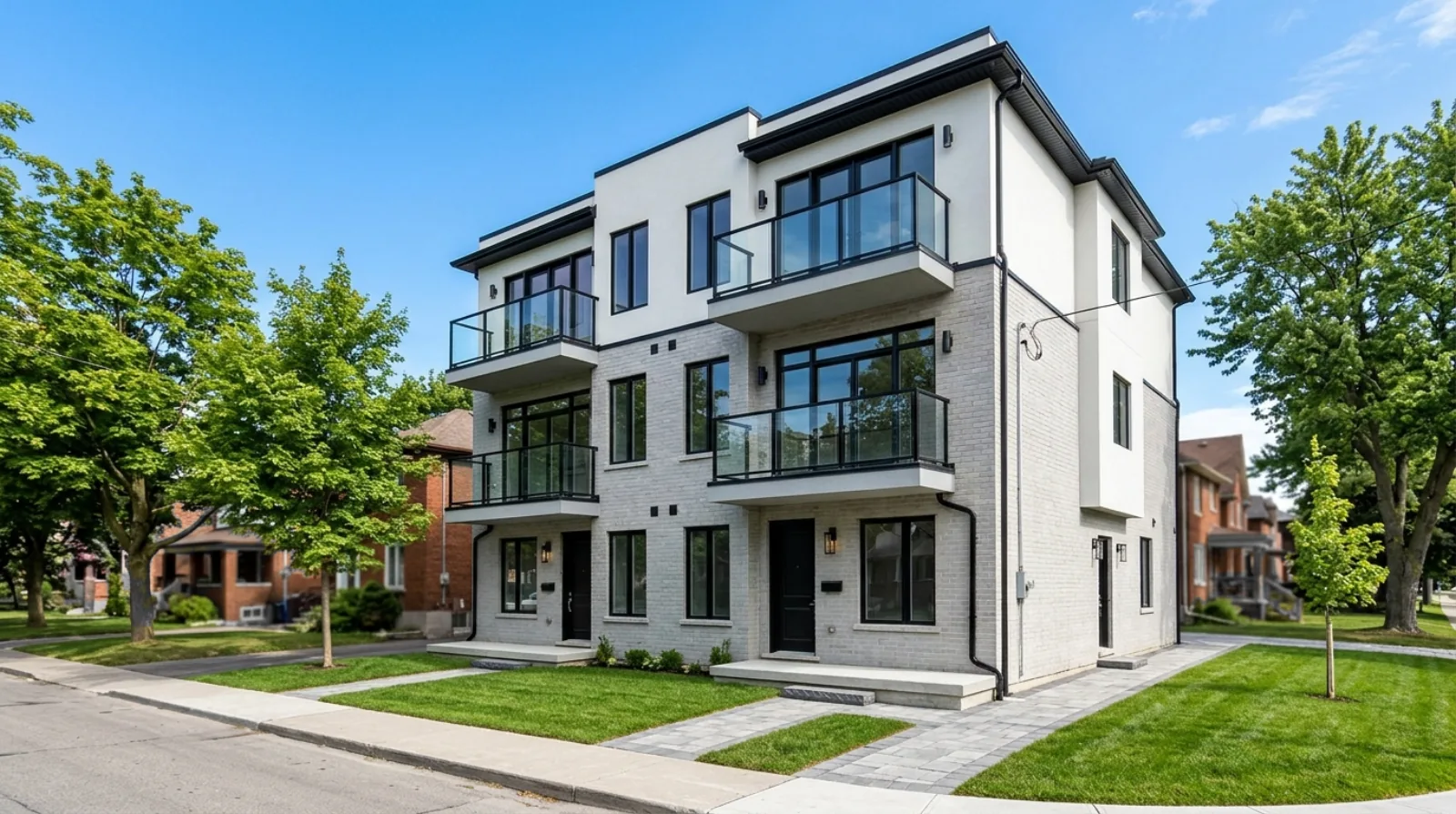
Is a fourplex worth it? The answer starts with another question: worth it compared with what? Keeping the house as it is, selling the lot to a builder, or building the fourplex yourself all lead to different numbers.
I'm Anthony Palleschi, a real estate sales representative in Toronto, and I work with owners and builders on lots like these. This post sets out the published figures and rules that go into the decision, as they read on November 1, 2026. Construction costs and financing depend on your builder and your lender, so this post gives no figure for them. Get quotes before you decide.
Step 1: can your lot hold four units?
A fourplex has to fit the lot before any number matters. Most residential lots in Toronto can hold a multiplex of up to four homes in one building, but the zone label, the lot's depth and frontage, the yards and any Chapter 900 exception decide whether four units fit. My guide to Toronto multiplex zoning walks through the count.
If your lot is in one of the nine sixplex wards, five or six units may be possible, which I cover in my post on which wards allow sixplexes. A garden suite or laneway suite can add a fifth home outside those wards, which I compare in my post on laneway suites, garden suites and multiplexes.
Step 2: what the units could rent for
The most reliable published rents for Toronto come from CMHC's Rental Market Survey. Its table of average rents by bedroom type for the Toronto area, covering purpose-built row and apartment rentals, shows:
| Unit type | October 2024 | October 2025 |
|---|---|---|
| Studio | $1,448 | $1,491 |
| One bedroom | $1,715 | $1,761 |
| Two bedrooms | $1,972 | $2,045 |
| Three bedrooms or more | $2,185 | $2,294 |
| All units | $1,852 | $1,917 |
CMHC rates all of these figures "a," its highest reliability code. These are averages across the whole rental stock in the Toronto area, old buildings and new. A new unit in a new fourplex can rent above or below them, depending on its size, finish and street.
As an example of the arithmetic only: four two-bedroom units at the October 2025 average would bring $8,180 a month, or $98,160 a year, before vacancy and costs.
CMHC's vacancy rate table for the same rentals shows 3.0 percent of units vacant in October 2025, up from 2.5 percent in October 2024. Two-bedroom units were at 2.5 percent and three-bedroom units at 1.8 percent in October 2025.
Step 3: rules that work in a fourplex's favour
Three published rules change the numbers for a new four-unit rental building.
City development charges
Under section 415-6 of the Toronto Municipal Code, the City does not charge development charges on the second, third or fourth unit, and charges $0 on a fifth or sixth, as long as the parcel holds no more than six units. A credit applies for a house demolished within 60 months before the building permit application. My post on the development charges exemption explains the details.
The GST/HST rental rebate
The Canada Revenue Agency's new residential rental property rebate page, last changed September 2, 2026, describes the purpose-built rental housing rebate. It is 100 percent of the GST, or the federal part of the HST, where:
- the units are part of a residential complex with at least four units, each with a private kitchen, a private bath and a private living area,
- at least 90 percent of the units are held for residential leases or certain exempt supplies,
- construction begins after September 13, 2023 and before 2031, and
- the building is "substantially completed" before 2036.
The same page says a rebate of 100 percent of the provincial part of the HST is available in Ontario where the federal conditions are met. This rule separates a triplex from a fourplex, because a three-unit building falls below the four-unit minimum. Ask your accountant how the rebate applies to your plan before you count on it.
Rent control
Ontario's residential rent increases page, updated June 23, 2026, says "New buildings, additions to existing buildings and most new basement apartments that are occupied for the first time for residential purposes after November 15, 2018 are exempt from rent control." The 2026 rent increase guideline of 2.1 percent does not limit rent increases on those units. The rest of the Residential Tenancies Act still applies to the tenancy.
Step 4: compare the three choices
This section is my own view of how to compare the choices once you have your numbers.
| Choice | What you need to know | Main risk |
|---|---|---|
| Keep the house | What it is worth today and what it costs to hold | The lot's extra value stays unused |
| Sell the lot to a builder | What a builder would pay for a four-unit lot | Selling before you know what the lot can hold |
| Build the fourplex yourself | Construction quotes, financing terms, rents, time | Cost or time over the plan, and the work of being a landlord |
Building yourself keeps the most value on paper and carries the most risk. Selling to a builder moves the risk to the builder, and the price reflects that. My post on how builders price land explains how a builder arrives at an offer, which is also a quick way to see whether the numbers work at all.
To test the "build" choice, put these items in one sheet:
- Rents for each unit, from CMHC averages and from current listings for similar new units on your street.
- Vacancy, using CMHC's rate as a starting point.
- Operating costs: property tax, insurance, utilities you pay, repairs and management.
- Construction quotes from at least two builders, with design, permits and demolition.
- Financing: the rate, the term and the amount your lender will advance.
- Taxes and rebates: land transfer tax if you buy, the GST/HST rebate if it applies.
- Time: months of design and approvals before construction, and months of building.
If the rents cover the costs with room left over, building may be worth it. If they do not, selling the lot to a builder, or adding one suite to the house you have, may be the better choice.
Questions to answer before you decide
- Does my lot fit four units under the zoning, or does it need a minor variance?
- Will at least 90 percent of the units be rented, so the GST/HST rebate can apply?
- What do two builders quote for the same drawings?
- What will my lender advance, and on what terms?
- How do my numbers compare with what a builder would pay for the lot?
Before you decide whether a fourplex is worth it, ask what your lot would be worth to a builder, so you have both numbers. If you want help with that, see how I work with sellers or developers, or reach me through the contact page or at 416-636-6800.
Planning and development potential is property-specific and subject to zoning, approvals, site conditions, municipal review and other due diligence.
Sources
All pages opened on November 1, 2026 (PT).
- CMHC, Housing Market Information Portal, Toronto, Historical Average Rents by Bedroom Type (Rental Market Survey, row and apartment, October): average rents for October 2024 and October 2025.
- CMHC, Housing Market Information Portal, Toronto, Historical Vacancy Rates by Bedroom Type (Rental Market Survey, row and apartment, October): vacancy rates for October 2024 and October 2025.
- Canada Revenue Agency, GST/HST new residential rental property rebate (date modified September 2, 2026): the purpose-built rental housing rebate and the Ontario provincial part.
- Government of Ontario, Residential rent increases (updated June 23, 2026): the 2026 guideline and the exemption for units first occupied after November 15, 2018.
- City of Toronto, Municipal Code Chapter 415 (consolidated to July 30, 2026): development charges on the second to sixth units and the demolition credit.
Frequently asked questions
Is building a fourplex in Toronto worth it?
A Toronto fourplex can be worth building when the lot fits four units under the zoning, the construction quotes and financing work, and the rents cover the costs. CMHC's October 2025 survey put the average two-bedroom rent in the Toronto area at $2,045 a month. Each owner has to test their own numbers against their own costs.
What rent can a Toronto fourplex unit get?
CMHC's Rental Market Survey for the Toronto area, October 2025, reported average rents in purpose-built row and apartment rentals of $1,491 for a studio, $1,761 for one bedroom, $2,045 for two bedrooms and $2,294 for three bedrooms or more. New units in a new building can rent above or below these averages.
Is a new Toronto fourplex under rent control?
Ontario's residential rent increases page says new buildings, additions and most new basement apartments first occupied for residential purposes after November 15, 2018 are exempt from rent control. The 2026 rent increase guideline of 2.1 percent does not apply to those units. Other parts of the Residential Tenancies Act still apply.
Does a fourplex qualify for the GST rental rebate?
The Canada Revenue Agency says the purpose-built rental housing rebate is 100 percent of the GST, or the federal part of the HST, for a residential complex with at least four units that each have a private kitchen, bath and living area, where 90 percent of units are held for residential leases. Construction must begin after September 13, 2023 and before 2031.
Does Ontario rebate the provincial part of the HST on a rental fourplex?
The Canada Revenue Agency's new residential rental property rebate page says a rebate of 100 percent of the provincial part of the HST is available for purpose-built rental housing in Ontario where the conditions for the federal purpose-built rental housing rebate are met. A fourplex that qualifies for the federal rebate can also claim the Ontario part.
Do Toronto fourplexes pay development charges?
Under section 415-6 of the Toronto Municipal Code, City development charges are not imposed on the second, third or fourth unit of a residential development of up to six units on one parcel. The first unit can be reduced by a credit for a house demolished within 60 months before the building permit application.
What is the vacancy rate for rentals in Toronto?
CMHC's Rental Market Survey put the vacancy rate for purpose-built row and apartment rentals in the Toronto area at 3.0 percent in October 2025, up from 2.5 percent in October 2024. For two-bedroom units it was 2.5 percent in October 2025, and for three bedrooms or more it was 1.8 percent.
What was the average rent for a one-bedroom in Toronto in 2025?
CMHC's Rental Market Survey reported an average rent of $1,761 a month for a one-bedroom unit in purpose-built row and apartment rentals in the Toronto area in October 2025, up from $1,715 in October 2024. The vacancy rate for one-bedroom units in the same rentals was 3.6 percent in October 2025.